
Hi friends, in this article, we will discuss an important topic in the world of data: Data Management.
More specifically, we will answer two fundamental questions: What is Data Management, and why is it important for organizations?
Data is one of the most valuable assets of modern organizations. However, simply collecting and storing large amounts of data is not enough.
To make effective use of data, organizations need to ensure that it is accurate, secure, accessible to authorized users, and properly managed throughout its lifecycle.
This is where Data Management comes into the picture.
Let’s explore what Data Management is, its main principles, its relationship with Data Governance, and how it helps organizations make better decisions.
What Is Data Management?
Data Management is the set of practices, processes, policies, and technologies used to manage data throughout its lifecycle.
Its main purpose is to ensure that data is properly collected, stored, organized, processed, protected, maintained, and made available for legitimate business purposes.
According to DAMA International, Data Management involves the development, execution, and supervision of practices that protect, control, deliver, and enhance the value of data assets throughout their lifecycle.
In simple terms, Data Management helps organizations treat data as an asset rather than just information stored in databases and files.
Data Management covers several important activities, including:
- Data acquisition: Collecting or obtaining data from different sources.
- Data storage and organization: Storing data using appropriate technologies and structures.
- Data processing: Transforming and processing data to support business operations and analysis.
- Data integration: Combining data from different systems and applications.
- Data quality management: Maintaining data that is accurate, complete, consistent, and fit for its intended purpose.
- Data security: Protecting data against unauthorized access, modification, disclosure, or loss.
- Data governance: Establishing accountability, policies, standards, and decision-making responsibilities.
- Data compliance: Supporting compliance with applicable data privacy, protection, and regulatory requirements.
- Data lifecycle management: Managing data from its creation or acquisition until its eventual archival or disposal.
As you can see, Data Management is much more than database administration or data storage.
It is a multidisciplinary approach that combines people, processes, and technology to help organizations manage their information assets effectively.
Understanding the Data Management Lifecycle
One important concept in Data Management is the Data Lifecycle.
The Data Lifecycle describes the different stages that data goes through, from the moment it is created or collected until it is no longer needed.
Although the exact stages can vary between organizations, a simplified lifecycle consists of the following:
- Data creation or acquisition: Data is generated internally or collected from external sources.
- Data storage and organization: Data is stored in databases, file systems, data lakes, or other suitable platforms.
- Data processing and integration: Data is validated, transformed, and combined with other information where necessary.
- Data usage and sharing: Authorized applications and users access data to support business operations, reporting, analytics, and other approved purposes.
- Data maintenance: Data is monitored, corrected, updated, and protected as required.
- Data retention and archival: Data is retained or archived according to business, legal, and regulatory requirements.
- Data disposal: Data is securely deleted or otherwise appropriately disposed of when it is no longer required and no longer subject to a retention obligation.
These stages are not always strictly sequential. For example, data security and data quality controls should apply throughout the lifecycle, not only at one particular stage.
Proper lifecycle management helps organizations reduce unnecessary data accumulation, improve efficiency, and manage data-related risks.
Why Is Data Management Important?
Now that we understand what Data Management is, let’s discuss why it is important.
Effective Data Management can provide several benefits to organizations, from improving the quality of business information to strengthening security and supporting regulatory compliance.
1. Improve Data Quality and Reliability
One of the main objectives of Data Management is to ensure that organizations can work with reliable data.
Imagine an organization that maintains customer information across several applications.
If the same customer has different addresses, incorrect contact details, or duplicate records across these applications, several business problems can occur.
For example, the organization might produce inaccurate reports, contact customers using outdated information, or make decisions based on inconsistent data.
Data Quality Management helps reduce these problems through practices such as:
- Data validation.
- Data profiling and cleansing.
- Duplicate detection and resolution.
- Data quality monitoring.
- Establishing quality rules and assigning responsibility for resolving data issues.
Some common dimensions of Data Quality include accuracy, completeness, consistency, validity, uniqueness, and timeliness.
It is also important to distinguish Data Quality from Data Integrity.
Data Quality describes how suitable and reliable data is for its intended purpose.
Data Integrity focuses on maintaining the correctness, consistency, and validity of data, including preventing unauthorized or unintended changes and enforcing appropriate data constraints.
The two concepts are closely related, but they are not exactly the same.
2. Improve Data Security
Another important benefit of Data Management is that it establishes practices for protecting data against different security risks.
These risks can include unauthorized access, accidental modification, malicious activity, and data loss.
Data Security typically focuses on three fundamental properties:
- Confidentiality: Ensuring that data is accessible only to authorized individuals and systems.
- Integrity: Protecting data against unauthorized or improper modification and helping preserve its correctness.
- Availability: Ensuring that authorized users and systems can access data when needed.
Common security controls include authentication, authorization, encryption, auditing, and access monitoring.
Backups, disaster recovery, and high-availability mechanisms can also help organizations maintain data availability and resilience.
However, it is important to remember that data redundancy, high availability, and backups are different concepts.
For example, having multiple copies of the same database does not automatically protect an organization from accidental deletion, logical corruption, or malicious changes.
Therefore, organizations need a combination of appropriate security, backup, and recovery practices.
3. Support Data Privacy and Regulatory Compliance
Organizations often process information that is subject to legal and regulatory requirements.
For example, organizations processing personal data within the scope of the European Union’s General Data Protection Regulation (GDPR) must meet the applicable requirements for that processing.
These requirements include principles such as:
- Lawfulness, fairness, and transparency.
- Purpose limitation.
- Data minimization.
- Accuracy.
- Storage limitation.
- Integrity and confidentiality.
- Accountability.
Effective Data Management can help organizations implement controls for data classification, access, retention, deletion, and auditing.
It can also support the ability to identify where personal data is stored and how it is processed.
However, good Data Management does not automatically guarantee regulatory compliance.
Compliance also depends on legal obligations, organizational responsibilities, documented procedures, and the effectiveness of the controls in place.
For more information about GDPR requirements, you can review the European Commission’s guidance on personal data processing principles.
4. Support Better Business Decisions
Organizations increasingly rely on data to make operational and strategic decisions.
For example, data can help organizations understand customer behavior, identify business trends, evaluate performance, and discover opportunities for improvement.
However, the quality of these decisions depends heavily on the quality and relevance of the underlying data.
If reports are based on inaccurate or incomplete information, the conclusions can also be incorrect.
Effective Data Management helps improve the reliability of the information used by Business Intelligence (BI), analytics, and decision-support systems.
This does not mean that good Data Management guarantees good decisions, but it provides a stronger foundation for making them.
5. Improve Operational Efficiency
Poorly managed data can create unnecessary work for employees and technical teams.
For example, different departments might maintain separate copies of the same business information, each with slightly different values.
This can lead to repeated data cleansing, manual reconciliation, inconsistent reports, and unnecessary operational costs.
By establishing common data definitions, integration practices, and quality controls, organizations can reduce these inefficiencies.
This is particularly important in environments with multiple business applications, databases, and data platforms.
What Is the Relationship Between Data Governance and Data Management?
Data Governance and Data Management are closely related concepts.
However, they are not exactly the same.
Data Management is the broader discipline responsible for managing data throughout its lifecycle.
Data Governance is a core discipline within Data Management that focuses on accountability, policies, standards, decision rights, and oversight.
In simple terms:
- Data Governance: Helps establish who is accountable for data, what rules apply, and how decisions about data should be made.
- Data Management: Includes the wider set of activities used to manage, protect, organize, maintain, and deliver data throughout its lifecycle.
For example, a Data Governance policy might require customer records to meet defined quality standards.
Data Management activities then implement the necessary validation, monitoring, and correction processes to help meet those standards.
Similarly, Data Governance might define data ownership and access policies, while technical Data Management teams implement the appropriate access controls and supporting infrastructure.
This is why Data Governance and operational Data Management practices must work together.
Infographic: Relationship Between Data Governance and Data Management
The following infographic illustrates how Data Governance and Data Management practices work together to support data quality, security, availability, and compliance.
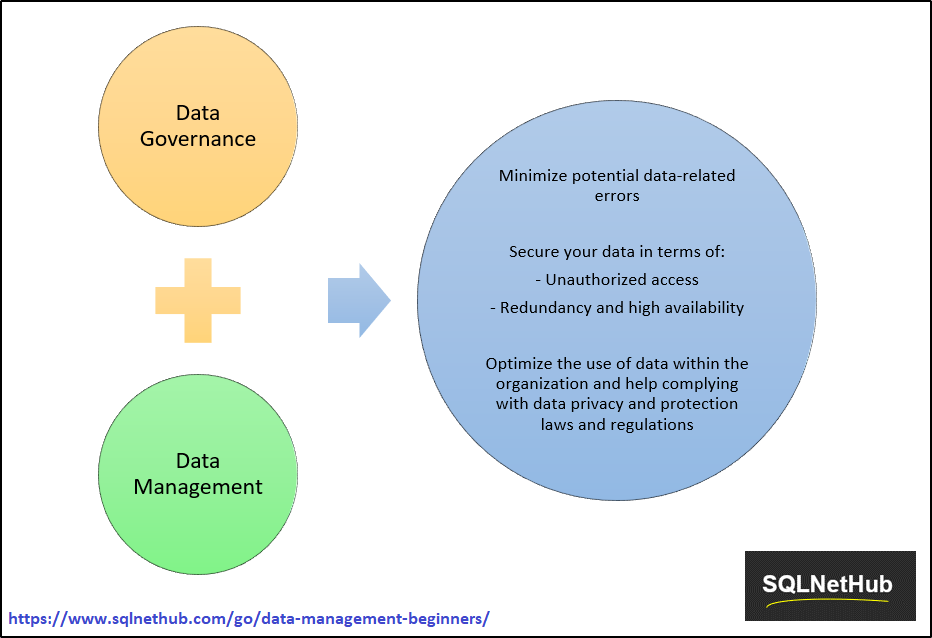
Note: The infographic provides a simplified illustration of how governance and management activities contribute to business outcomes. In established frameworks such as DAMA-DMBOK, Data Governance is considered a central discipline within the broader Data Management framework, rather than a completely separate domain.
Key Roles in Data Management
Another important aspect of Data Management is the assignment of clear responsibilities.
After all, data cannot be effectively managed through technology alone.
Organizations also need people who are accountable for its definition, quality, protection, and use.
Some common roles include:
- Data Owner: Accountable for decisions about a specific data domain or asset, according to the organization’s governance model.
- Data Steward: Helps maintain data definitions, quality standards, and the implementation of governance practices.
- Data Custodian: Responsible for technical activities such as storing, protecting, and maintaining data in the relevant systems.
- Data Architect: Designs data structures, integration patterns, and architectural solutions aligned with business requirements.
- Data Engineer: Develops and maintains the pipelines and processes used to move, transform, and deliver data.
The exact responsibilities and job titles can vary between organizations.
The important thing is to establish clear accountability and avoid situations where critical data assets have no defined ownership.
A Practical Example of Data Management
Let’s consider a simple example to better understand how Data Management works in practice.
Imagine an organization that stores customer information in several systems, such as:
- A customer relationship management (CRM) system.
- A billing system.
- A customer support application.
- A reporting and analytics platform.
Without proper Data Management, each system might contain different versions of the same customer’s information.
For example, a customer’s address might be correct in the CRM system but outdated in the billing system.
Consequently, the organization might send invoices to an incorrect address or generate reports based on inconsistent information.
To address this issue, the organization could implement several Data Management practices:
- Define data ownership: Assign accountability for customer data and its quality.
- Establish quality rules: Define validation requirements and identify duplicate or inconsistent records.
- Implement data integration: Establish controlled mechanisms for keeping relevant customer information consistent between systems.
- Protect sensitive information: Apply appropriate access controls, encryption, and auditing.
- Document data definitions: Maintain common business definitions and metadata so that systems and teams interpret the information consistently.
- Apply retention requirements: Retain and dispose of information according to applicable business and legal obligations.
- Monitor data quality: Continuously measure data quality and investigate identified issues.
By implementing these practices, the organization can improve the consistency and reliability of customer information across its systems.
Of course, the exact implementation will depend on the organization’s architecture, business processes, and regulatory environment.
Why Data Management Is Also Important for AI
In recent years, Data Management has become even more important because organizations increasingly use Artificial Intelligence (AI) and advanced analytics.
AI systems depend on data, whether they use it for model training, evaluation, analytics, or retrieving relevant information during execution.
For example, consider an AI application that uses Retrieval-Augmented Generation (RAG) to answer questions based on organizational documents.
Even if the underlying language model is highly capable, the quality of the generated answers can suffer when the retrieved information is outdated, inconsistent, incomplete, or irrelevant.
Furthermore, poorly configured data access controls could allow an AI application to retrieve information that a particular user should not be authorized to access.
This is why effective Data Management is important for enterprise AI solutions.
Some key areas include:
- Data Quality: Ensuring that the information used by AI applications is sufficiently accurate, complete, and relevant.
- Data Governance: Establishing policies and accountability for how data can be used.
- Data Security: Enforcing appropriate access controls and protecting sensitive information.
- Metadata Management: Providing context about datasets, documents, their meaning, and intended use.
- Data Lineage: Understanding where data originated and how it has been transformed or processed.
- Data Lifecycle Management: Ensuring that data is maintained, updated, retained, or disposed of according to applicable requirements.
However, good Data Management alone does not guarantee that an AI system will produce accurate or appropriate results. Model behavior, evaluation, application design, and other AI-specific controls are also important.
The main point is that well-managed data provides a stronger foundation for developing reliable and trustworthy AI solutions.
How to Get Started with Data Management
If your organization is taking its first steps toward implementing a more structured Data Management approach, you do not necessarily need to start with a large and complicated program.
A more practical approach is to begin with a few important activities.
- Identify critical data assets: Determine which datasets and information systems are most important for your business operations.
- Assign responsibilities: Define who owns and manages those data assets.
- Evaluate data quality: Identify common problems such as missing values, duplicate records, and inconsistent definitions.
- Review security and compliance requirements: Understand which controls and obligations apply to the relevant data.
- Establish policies and standards: Define how data should be collected, stored, accessed, maintained, and disposed of.
- Monitor and improve: Measure the effectiveness of your practices and make improvements over time.
Starting with a small number of critical data assets can help demonstrate the business value of Data Management before expanding the approach across the organization.
Concluding Remarks
Data Management is an essential discipline for organizations that want to use their data effectively, securely, and responsibly.
As we discussed in this article, it involves much more than simply storing information in databases.
It covers the entire data lifecycle and includes important areas such as Data Governance, Data Quality, Data Security, Data Integration, and Data Compliance.
By implementing appropriate Data Management practices, organizations can improve the reliability of their information, reduce operational inefficiencies, strengthen data protection, and support better business decisions.
These practices also provide an important foundation for modern analytics and AI applications.
However, successful Data Management requires more than technology. It also depends on clearly defined responsibilities, appropriate policies, effective processes, and a culture that recognizes the value of data.
The main thing to remember is simple: collecting data creates potential value, but managing data properly helps organizations realize that value.
Hope this helps!
References
- DAMA International – What Is Data Management?
- Microsoft Learn – Planning for Data Governance with Microsoft Purview
- European Data Protection Board – Basic Data Protection Principles
Continue Learning Data Management
If you want to build a stronger foundation in Data Management and Data Governance, explore my Data Management for Beginners – Main Principles course on Udemy.
The course introduces the main principles of Data Management and explains why they are important for organizations that want to manage their information assets effectively.
Through structured lectures, practical examples, infographics, and quizzes, you will explore topics such as Data Governance, Data Quality, Data Security, Data Compliance, Data Auditing, and the responsibilities of Data Owners, Data Stewards, and Data Custodians.
You will also learn useful techniques for creating and maintaining a data-driven culture within an organization.
Whether you are a Data Professional, IT Manager, or simply interested in understanding the fundamentals of Data Management, the course provides a structured starting point.
Review the curriculum and available preview lessons to see whether it matches your experience and learning goals.
View the course and current offer. Pricing and coupon availability are determined on Udemy.
Read Also
- What Is Data Compliance within the Data Management Scope?
- Data Management for Beginners – Main Principles (Course Overview)
- What Are Relational Database Management Systems (RDBMSs) and the SQL Server Data Platform?
- What Is Data Security and Which Are Its Main Characteristics?
- Differences Between Batch and Streaming Data
Stay Connected
Subscribe to the GnoelixiAI Hub Newsletter on LinkedIn for practical insights on AI, data, and technology.
Watch more on YouTube: SQLNetHub TV and my personal channel.
Originally published on SQLNetHub.
© SQLNetHub

Artemakis Artemiou is a seasoned Senior Database and AI/Automation Architect with over 20 years of expertise in the IT industry. As a Certified Database, Cloud, and AI professional, he has been recognized as a thought leader, earning the prestigious Microsoft Data Platform MVP title for nine consecutive years (2009-2018). Driven by a passion for simplifying complex topics, Artemakis shares his expertise through articles, online courses, and speaking engagements. He empowers professionals around the globe to excel in Databases, Cloud, AI, Automation, and Software Development. Committed to innovation and education, Artemakis strives to make technology accessible and impactful for everyone.